The Labour We D̶o̶ N̶o̶t̶ Dream Of

“Darling, I don’t have a dream job. I don’t dream of labour.”
Although often misattributed to James Baldwin’s conversation with Nikki Giovanni, this apocryphal quote still echoes across corners of the internet as a resistance against late-stage capitalist realities, which demand that life be centred around work – nay that life must be traded for it. Beyond imposing on Baldwin’s posthumous personhood, this sentiment may also be misappropriated to justify outsourcing work to non-human ‘assistants’, while neglecting the immense human labour behind it. This convenience of choosing to not dream of labour, is, however, only made possible by subjecting others to the nightmares of the labour conditions required to fabricate ‘ease’ of work. The promises of Artificial Intelligence (AI) simplifying work are challenged by evidence that, much like the introduction of earlier technologies, it is expected to have varied and complex implications on work and the workforce.
In observance of International Labour Day (International Workers' Day or May Day), this piece historicises AI and work within global labour movements, as a reminder to uphold the foundational calls for fair and safe workplaces, and as an invitation to expand calls for just labour conditions within the context of AI. Considering how these systems driving the purported Fourth Industrial Revolution (4IR) rely on workers in Majority-World countries and contexts, this article makes the case that the labour movement in the ‘AI era’ must be rooted in the Global Majority. It finally reflects on initial thoughts from the Embodied AI Safety Workshop (held by Careful Industries and the Global Center on AI Governance last month), which will be further explored in upcoming collaborative research outputs, as a prompt to consider what forms of labour we may choose to reclaim for re-imagining the future of work.
MayDay! The Foundations of the Labour Movement have been Eroded
International Workers’ Day emerged from the 19th-century struggle for improved better conditions in industrial cities across America. It commemorates the initial recognition of the eight-hour workday in six states, and honours labour activists who faced violent clashes at the Haymarket affair in Chicago, with whom global labour movements stood in solidarity to sustain the fight for labour justice. May Day is both a commemoration of the struggle for improving working conditions and a reminder to continue dismantling oppressive labour structures, old and new.
The labour movement historically rallied behind the slogan, "eight hours for work, eight hours for rest and eight hours for what you will”, calling for one’s control over time beyond work, and thus, for the freedom of workers’ lives. However, in the age of digital labour we are witnessing (and experiencing) a regression in all three hard-fought demands: working unbound times, compromising rest, and surrendering our agency to algorithms that dictate our daily lives.
Relativity of the 8 Hour Work Day
The philosophical threads of the relativity of time help us connect why labour rights movements originating from the Global North may not translate universally. The call for a standardised workday does not fully consider sociocultural particularities including seasonal labour, varying perception on the role of work in people’s livelihoods, and work that exists outside conventional employment. It also overlooks care work, which falls between the cracks of unrecognised work performed not only out of will, but also social obligation and personal responsibility.
The politicisation of ‘informal labour’ further highlights that although most workers in the Global Majority are engaged in such forms of work without collective rights or social safety nets, they are rarely considered in labour scholarship and movements. William Shoki, editor of Africa Is a Country, also observed in his weekly newsletter (February 2026) how religious and cultural celebrations move with different rhythms from capitalist time, which privatises communal time into individual schedules to be negotiated with employers.
Unjust labour relations cannot be radically addressed by flattening and segmenting time; it requires us to look beyond capitalist conventions as the standard to ask instead: How is our time working, experienced and felt? And how can we make working conditions fair and just for all?
To reclaim Baldwin’s account in “Song” from Jimmy’s Blues and Other Poems, as those who have studied him have noted that he saw himself as a poet more than anything else, we can see that Jimmy invites us to look at time as more than a space in which money is made
Time is not money.
Time
is
time
The Case for a Global-Majority Led Labour Movement in the 4IR
The digitally-enabled “Fourth Industrial Revolution (4IR)” is a continuation of its preceding industrial eras, demanding higher productivity, and placing significant pressure on the global workforce, which disproportionately impacts workers in the Global Majority engaged in different forms of data work.
What has been [over]simplified as “data” is years of knowledge, labour, and embodied experience of lives lived. Datafication is an inherently reductive process of capturing parts of the human experience ( limited to the computable aspects) that has been used to monetise humanity, thereby deepening the homoeconomicus paradigm. Thus, production of data itself should be recognised as a form of labour that warrants users to insist on tools that improve working environments, and not worsen them.
Data production for the design and operation of AI systems relies on the invisibilised labour of data workers, many of whom are in Global Majority countries, labeling, annotating and moderating immense amounts of information into datasets necessary for sustaining AI systems. Much like the Australian stonemasons in Melbourne, who achieved the first victory for an eight-hour workday (1856) while chiseling the building blocks of the Industrial Revolution, data workers performing the foundational tasks for the 4IR have been at the forefront of contemporary labour movements calling for just working conditions within the AI sector. This movement must be centred in the continued efforts to establish fair working conditions throughout the AI ‘lifecycle’ and across the value chain.
AI Safety as an Embodied Experience of Labour
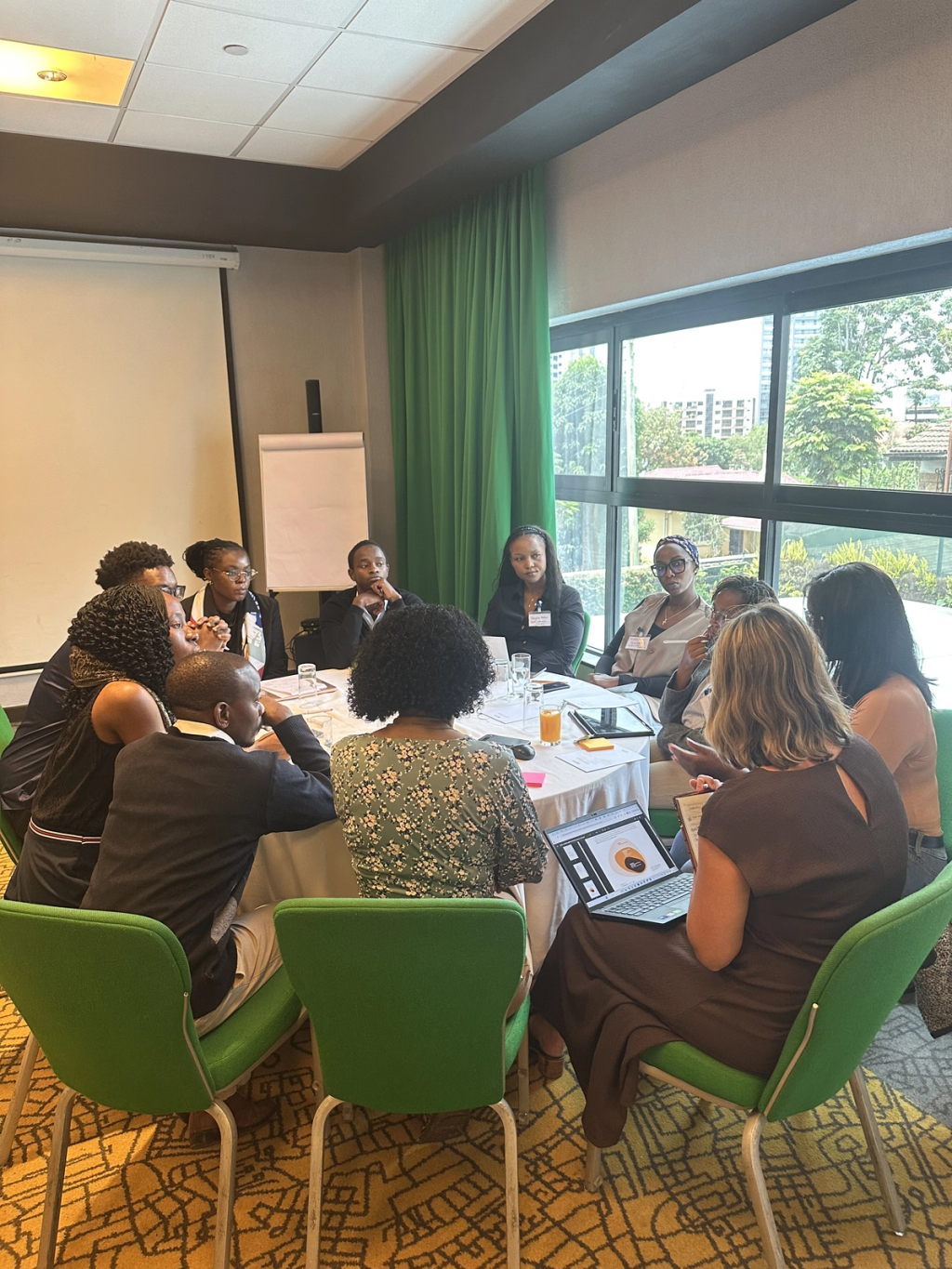
On April 15 and 16, 2026 the Global Center on AI Governance (GCG) partnered with Careful Industries, to co-host a multistakeholder workshop on AI Safety with contributions from the Data Labelers Association (DLA), Qhala and the Centre for Intellectual Property and Information Technology Law (CIPIT). The workshop, which was part of the Lloyd's Register Foundation supported Foresight Review on the Safe Adoption of AI, explored how different actors understand “ AI Safety” i.e. safely made, safe to deploy, safe to use and maintain, as an embodied experience. Participants were invited to envision ideal visions of AI safety, and outline the resources and conditions required to make these imagined [near] futures a reality.
In her newsletter, Just Enough Internet, Rachel Coldicutt (whom I had the pleasure of co-facilitating the workshop in Nairobi, Kenya) offers a brilliant reflection and insights into the themes that were discussed during our convening.
The workshop’s discussions revealed that when we confront the materiality of AI safety, it shatters the illusion that digital advancement absolves us of labour. The insight report on the working conditions of data workers (forthcoming) developed in partnership with the DLA and Uche Anyamele (PhD) presented at the event aligns with findings from the Data Workers’ Inquiry research project , which has revealed that African content moderators experience higher levels of psychological distress and lower wellbeing compared to their counterparts elsewhere. What this unveils is how digital labour is embodied, and therefore an issue of safety, wellbeing as well as physical and mental health.
In the coming months, we look forward to sharing research outputs from this project, which also illustrate the ideal working conditions from the perspectives of data workers, which you can stay updated on here.
The Labour We are Robbed Of – the ‘outsourcing trap’
We must also consider particular forms of labour that we may choose to not outsource, as they are deeply intertwined with the human experience, and there are two things that come to mind here: the process of rigorous intellectual labour, and care labour.
African intellectual traditions may offer valuable perspectives on the merits of cognitive labour (broadly defined to avoid tangential debates on what this really means). For instance, Qiné, an Ethiopian hermeneutic practice , uses the wax (säm) to express hegemonic understandings of the world and the gold (wärq) , a meaning that only becomes accessible through extensive interpretation. An integral part of deciphering these multiple meanings is a period of ‘meditation’ (qisäla) and ‘gädl’ (struggle) before reaching ‘emancipation’ (arnät) after having deciphered the gold. When we opt out of the frustration of labouring to extract multiple interpretations from the wax by outsourcing our intellectual labour, we risk experiencing the world only as it is, and forfeit the eureka moment that emerges from the struggle to find the gold – the world as it should be.
Considerations of care labour must also expand beyond the domestic sphere to include tending to one another and our more-than-human environments. This includes visibilising and fairly compensating the work that digital systems depend on, and attending to the material implications of using these technologies on the land and water we inherited and must protect for future generations. We must not create working and living conditions that require us to forgo care, which is deeply tied to the human experience (again, avoiding existential questions for brevity here). We simply cannot afford to not care, because our humanity – and the humanity of others– depends on it.
Note of gratitude: My sincere thanks to Leah Junck, PhD and Shyline Muthoni from GCG; Rachel Coldicutt and Rachael Burton of Careful Industries; Joan Kinyua and Ephantus Kanyugi from the Data Labelers association, and Uchenna Anyamele for organising the Embodied AI Safety Workshop, and Njunge Wanjiru for helping us visually capture our discussions as well as everyone who joined us in Nairobi for inspiring the ideas explored in this article.
To learn more about the history of Labor Day, please see the Smithsonian's archive collection Labor Day: Celebrating the Achievements of the American Worker and Labor Movement here.