
Small is beautiful, but scale gets the job done: Pathways for AI industrialisation in Africa.

The age of industrial policy being a taboo is over. Nearly every major international institution, including the World Bank, the IMF, and several mainstream development agencies, now agrees that some form of state intervention is needed to develop strategic industries and correct market failures. This consensus extends to artificial intelligence (AI), which presents its own market failures, such as information asymmetries and delayed diffusion that justify public intervention, particularly in developing economies. My experience sitting in several policy discussions in the African context is that economists, policymakers, and practitioners all agree on devising industrial policies for AI, though for different reasons. Practitioners recognise that governments are better positioned to absorb early adoption costs. Policymakers worry about the concentration of AI capabilities in a few non-domestic frontier firms. And many African economists have long backed developmentalism, anyway.
What we have yet to agree on is exactly what path AI industrialisation (the transition to large-scale industrial development and application of AI) should take. This was the central question at the UNIDO Expert Group Meeting on AI and Industrial Policy in Africa held in Addis Ababa two weeks ago, where I had the opportunity to present my thoughts on the topic. Preparing for that talk took me back to a classic development debate I first encountered in grad school: should developing countries lean into existing comparative advantages, or should they bet boldly on building domestic capabilities from scratch in new advanced industries?
This distinction matters because the controversies around industrial policy’s downsides (state capture, market distortions, etc) often arise from reducing a very broad policy instrument to protectionism or picking winners. Beyond classic tools like subsidies and tax incentives, AI demands more precise interventions, such as building shared compute infrastructure and coordinating skills development where private actors alone will underinvest. Getting the pathway right determines whether African states can rightly scale their domestic AI sectors industrially.
Comparative or competitive advantage?
The debate between Justin Lin and Ha-Joon Chang, first published in 2009, remains one of the sharpest framings of this question. Lin argues for an endogenous approach in which developing countries facilitate industries exploiting their existing factor endowments, such as a relative abundance of labour and natural resources, first. Governments coordinate the emergence of firms, which then accumulate enough physical and human capital in current factor endowments and channel it into more advanced industries. Attempting to leapfrog into new capital-intensive industries without a sustained exploitation of existing areas of strength only breeds infant industries and rent-seeking perpetually, Lin argues. Chang counters that the comparative advantage framework understates how much of the gap between rich and poor countries stems from differences in technological know-how. Technical know-how and optimal use of capital for it are only embodied through specific production processes, and the expertise to use technology develops only through hands-on involvement. A country cannot wait until its endowments are "right" to enter an advanced industry. Rather, it must enter the industry to build the organisational routines and institutional knowledge required.
While comparative advantage offers a useful starting point (countries should leverage what they already have), the most successful industrialisers in history treated it as a launchpad, not a ceiling. Nokia's electronics division survived on cross-subsidies for seventeen years before it became profitable while South Korea ventured into steel production, establishing POSCO in the late 1960s, when its per capita income was only about $245.
I believe the competitive advantage framing carries more weight for Africa’s AI pursuit. Rather than being fixated on current bottom-of-the-pyramid endowments (outsourced AI labour, raw materials for semiconductor production), African countries should attempt to develop up the value chain by doing, experimenting, and failing forward. This path demands thinking about scaling, not just participation in the AI value chain. And to achieve this, the glamourisation of small and medium enterprises as the primary engine of African development, long promoted by international development agencies, will not deliver transformative change in AI. SMEs matter for employment and livelihoods, and startups can serve as an entry point through which countries first develop muscle in a new industry — early firms build management capacity and engineering know-how that creates a self-reinforcing cycle of skill and capital accumulation. More so, AI startups should be supported to enable diffusion, especially to hard-to-reach populations. However, startups rarely generate the R&D investment, data infrastructure, or cross-sector coordination that AI industrialisation requires. What competitive advantage prescribes goes beyond nurturing startup ecosystems. It calls for investing in industries at a scale sufficient to drive large-scale industrial innovation from the outset, which is a fundamentally different proposition from distributing resources across pockets of small startups and hoping that scale emerges organically.
Consider, for example, if an African government wanted to build capabilities in advanced semiconductor fabrication, the competitive advantage approach would channel targeted interventions toward a domestic electronics manufacturer, or make a deliberate bet on building that capacity from scratch, rather than spreading thin support across dozens of early-stage ventures. Formal, large-scale firms are needed to absorb the fixed costs of AI adoption, create quality jobs, anchor supply chains, and compete in markets where returns to scale are enormous. As experiences from many ICT4D projects failing due to poor infrastructure linkage and short-term funding show, an AI industrial strategy built around “small is beautiful” will not go beyond aid-funded “adoption” of frontier AI tools to the benefit of a small segment of the population.
Scaling the competitive advantage way.
How can African countries compete in the AI value chain, in which only a handful of countries possess disproportionate advantages in skills, capital, R&D spending, and energy infrastructure?
The truth is, African countries cannot realistically catch up across every layer of the stack. And they do not need to. What states can focus on, instead, is discovering and cultivating what, borrowing from Chang, I call “undiscovered differential capacity” — areas where existing strengths or unique conditions can be leveraged into competitive positions in a new industry that others cannot easily replicate. Chang's central insight is that countries building new capabilities rarely have a clear advance picture of whether the bet will pay off. TSMC was founded in Taiwan in 1987, at a time when Japan dominated the semiconductor industry. Taiwan had no obvious comparative advantage in chip fabrication; what it had was a deliberate government strategy to carve out a niche in contract manufacturing that the dominant players had overlooked. China is applying this same logic to AI.
Jensen Huang, Nvidia's CEO, has described AI as a five-layer cake in which every successful application pulls on every layer beneath it. African countries need not master every layer of this cake, but they must identify where along the stack their particular combination of endowments, sector knowledge, and market proximity creates an opening.
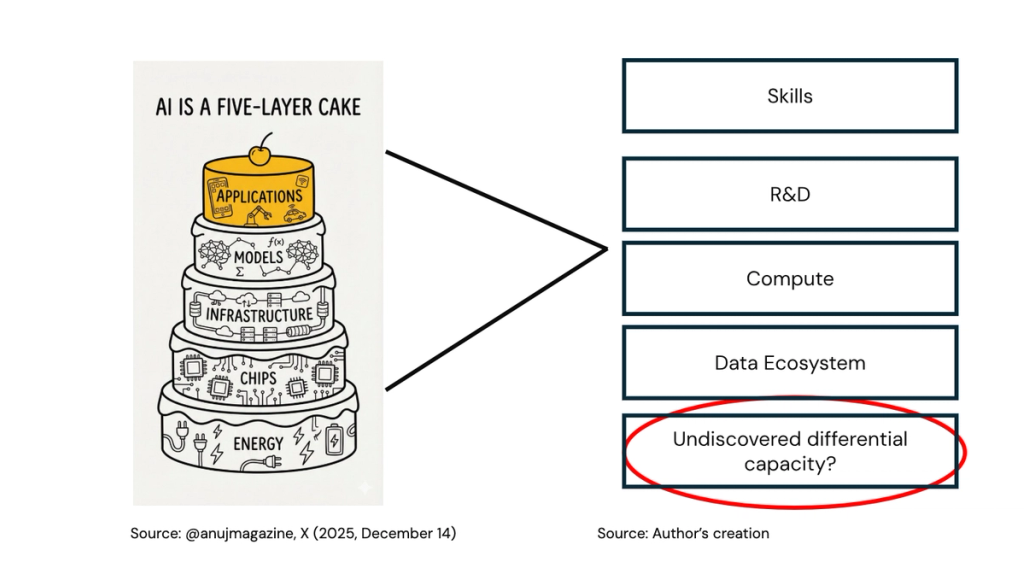
A few steps are useful in this pursuit:
- First, audit the current state of AI diffusion and build capabilities backwards. Which sectors are driving adoption, and where is demand pulling technology into production? Understanding the ground reality reveals which capabilities are missing and where investment should flow — both horizontally, across key sectors like agriculture, mining, financial services, and health, and vertically within the AI stack.
- Second, look beyond large language models: LLMs have dominated how governments and firms talk about AI. But AI is far broader; robotics, industrial automation, computer vision, predictive maintenance, all represent domains where African countries can build meaningful production capabilities. These architectures are general-purpose, but they need steering into specific applications where local knowledge gives domestic producers an edge.
- Third, combine differential capacity with meaningful use. Production and deployment are not mutually exclusive, and countries can pursue both, though production carries greater long-term power. Some questions to think about here are what superpowers do African economies already possess in agriculture, extractives, logistics, or demographic-scale services, and how can AI reshape these sectors into new competitive positions?
Of course, it is important to acknowledge the role of institutional conditions and geopolitical (especially US) support in the industrial policy successes we see in East Asia. But the notion that African governments today are inherently incapable of a society-wide industrial revolution because of their political and institutional challenges is not entirely true. As several experts have noted, the political and institutional challenges African states face today are comparable to those faced by developed countries when they were still developing, yet the latter managed to institute successful reforms in key sectors. The other caveat is that, yes, these strategies require extensive capital investment, which African countries cannot afford given competing priorities; however, the goal is not to outspend or outperform frontier AI nations. It is rather to find the seams in the global AI value chain where targeted investment and coordinated state action can build durable advantages that allow African economies to participate in the AI era on terms they help define, rather than terms dictated to them.