
AI at the Frontier of the New Industrial Policy Turn: How Should African Countries Respond? PART 2

PART 2
Devising feasible industrial policies for AI
Part 1 of this piece argues that African countries should not let concerns about state capacity, potential AI bubble burst, and fiscal feasibility prevent them from charting bold industrial ambitions for AI development.
Industrial policy requires long-term, continuous government efforts. While the policy environment will look different for respective African countries, some universally applicable recommendations are proposed as starting points:
- Embed targets for connectivity, compute, data, and research in national AI strategies
The current wave of AI strategies on the continent must integrate some industrial policy targets into their framework. Innovation and regulation are no longer considered opposing ideals, so African countries can structure their AI strategies as one comprehensive blueprint toward AI development and governance.
There is a range of tools in the industrial policy bucket, but generally these are classified into two types: supply chain policies (market interventions) and demand side policies (government action to stimulate demand for certain goods and services) (See Table 1 below). While industrial policies often have multiple objectives — including in the AI context, building self-sufficiency in the supply chain, developing domestic capabilities, or boosting productivity — a feasible AI industrial strategy should have few goals and deploy select tools, given capacity constraints in African countries. The type of policies adopted will depend on the capabilities countries aim to build. For instance, measures such as import quotas or foreign direct investment incentives might be easier to implement, whereas fiscal instruments such as R&D and tax incentives might require greater administrative inputs. Such strategies must also have sunset conditions, i.e. conditions and an end date to government support, in addition to firm-specific requirements to qualify for market-based interventions.
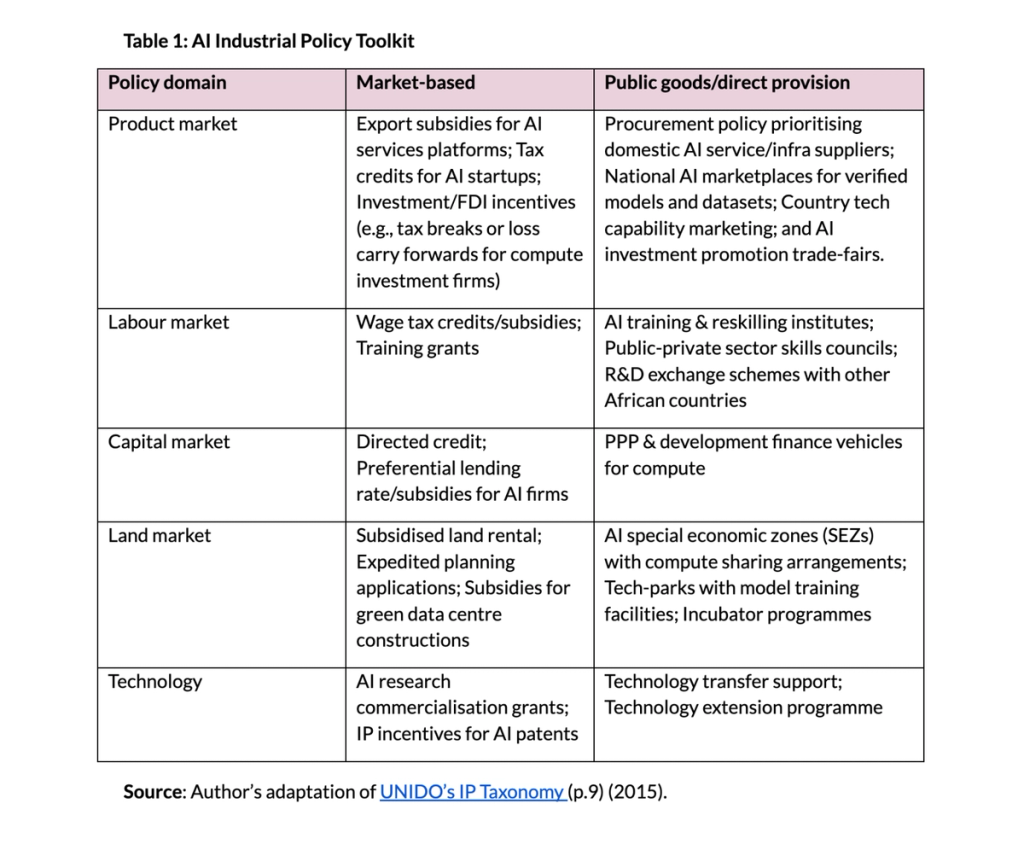
Importantly, an AI industrial strategy must contain a capacity-building plan across four areas: connectivity, compute, data, and research. Many African countries already have existing institutional vehicles handling each of these respective layers. South Africa, for example, has set up three interconnected institutions to support cyberinfrastructure needs — the Centre for High Performance Computing (CHPC) handles public sector compute needs, the South African National Research Network (SANReN) provides high-bandwidth connectivity and advanced services for research and education institutions as part of the national cyberinfrastructure, while the Data Intensive Research Initiative of South Africa (DIRISA) provides the infrastructure for data storage and management. Extensive skills development programmes are being carried out in places like Nigeria and Senegal; the 3million technical talent (3MTT) and FORCE-N programmes, respectively. Kenya’s Konza Technopolis, which is expected to host green-energy-based data centres, provides an excellent example of land-based industrial policy. The key task for these countries is creating structured institutional mandates, targets, and incentives for these existing strategic areas (or other choice areas) — for example, research and development (R&D). Individual national efforts are equally important to realise continental investment goals, such as the pledged $60billion AI investment fund.
- Framing AI compute as Digital Public Infrastructure (DPI)
Digital public infrastructure (DPI) has increasingly gained prominence as essential to building inclusive and interoperable public service delivery. They are seen as cost-effective, public-driven alternatives to wholly private sector-led tech development. DPIs – whether payment systems, data exchange platforms or digital identity rollouts — are also being used to address market failures where private actors have no incentive to step in or where such interventions are too costly (India’s use of United Payments Interface to address financial inclusion challenges is a key example here). Thus, a major difference between DPIs and conventional digitalisation mechanisms is the former’s focus on public value. Framing AI compute as a digital public infrastructure rather than a private resource allows the conversation on AI development to be centred on public value creation rather than private interests. This includes prioritising equitable resource sharing, targeting underserved innovators, and strategic sector application (such as net-zero ambitions and job-augmenting applications). State-led development – known as “public compute” or “public AI”– is already gaining traction in many parts of the world, and there are well-documented insights from these that can shape Africa’s choices in this regard. Of course, any meaningful investment still has to incorporate private capital — as do the many successful DPI cases which are driven by PPP vehicles.
- Map compute capacity, needs and projections
While the fact of Africa’s AI compute deficit needs no further proof, a mapping exercise is crucial to understand specific national or regional capacity gaps and variations and what is needed to achieve national AI development goals. Such exercise should contain a detailed report on the current capacity of data centres and compute clusters on the continent — including the type of GPU models in operation, energy capacity and cost, cloud regions and ownership structures (public or private), usage demands, connectivity latency, and other tech specifications. These details help policymakers benchmark infrastructure investment against actual needs, support resource allocation efficiency by ensuring that compute capacity is evenly distributed to key tech clusters across and within countries, and provide certainty to investors and industry stakeholders regarding investment plans. From an industrial policy planning point of view, clear knowledge of the physical distribution of compute infrastructure allows governments to enforce regulatory standards, manage access, map sectoral use, and make projections about availability and distribution to strategic priority sectors of AI use.
Beyond infrastructure development planning, another type of mapping exercise is crucial: identifying potential points of strategic leverage for African countries in the AI value chain. Too often, conversations about Africa’s AI advantage focus on the critical contribution of its vast minerals to the semiconductor industry or the vast potential of its booming labour force. These advantages tend to be overestimated — for example, Africa’s rare earth minerals only constitute 5% of the global composition, and the rare minerals currently used in the semiconductor industry are predominantly from China. A comprehensive mapping allows African countries to identify other points of advantage specific to their geographic, political and economic contexts — beyond the current fixation on talent stock and minerals supply for the semiconductor industry (itself an industry with a fragmented and long supply chain beyond critical minerals).
- Agentic systems: Industrial policy for the future
Industrial policy, by its very nature, proactively plans for the future by anticipating potential economic trends and challenges and investing in strategic industries to realise or mitigate those changes. While predicted trends in AI innovation — such as the shift to agentic systems, artificial general intelligence (AGI) and super intelligence — are speculative and require more robust evidence on their economy-wide productivity impacts, even a small-scale adoption of these technologies by large firms (which tend to be generally more optimistic toward technology adoption) can have significant impacts on the labour market, regulation, and infrastructure needs. It is important that IPs actively shape the course of these anticipated changes by planning, funding and regulating the infrastructure, R&D and human capital requirements of these systems.
Challenges
There are several challenges associated with instituting industrial policy for AI. Many of these are classic issues of inefficiency associated with IPs. First is the challenge of potential misallocation of resources, since industrial policy’s specific targeting of certain industries automatically diverts resources from non-priority sectors. Without alternative revenue sources to fund untargeted sectors, they shrink, reducing overall economic productivity. Crucially, the issue for African countries is not merely a trade-off between high and low-productivity sectors, but also considerations for critical public services such as healthcare and education, which are currently chronically underfunded. More so, for an industry already “suffering” from hyped perceptions of productivity, IPs could create the wrong kind of incentives for the AI market — providing firms with artificial advantages that, in the long run, render small and medium-scale businesses less efficient and competitive and give big firms monopolistic control of the market. Relatedly, any systemised subsidy, even with a sunset clause, is hard to get rid of, potentially leading to regulatory capture or crony capitalist practices.
Secondly, IPs require large fiscal and human capital inputs with a limited guarantee of returns. Even when gains are realistic, they take time to materialise, and their effects are hard to measure. This is the case even with IPs applied to more stable industries and economies with stronger institutional conditions.
The other issue is whether African countries can realistically catch up with the current progress in the global AI ecosystem, given the already massive structural deficiencies in their manufacturing base and human capital (e.g currently low levels of STEM education) — elements that are critical to AI development, but which themselves take time to build.
Conclusion
Developing a comprehensive and inclusive African AI ecosystem is an arduous task: meaningful and feasible industrial policy is difficult given current capacity constraints, but so is giving up on domestic infrastructural capacity development that IPs might help deliver. While it is true that any industrial AI policy ambition African countries may put in place is already constrained by limited resources, the lack of a clear strategic approach toward AI development is an even greater risk to Africa’s AI future. The telecommunications revolution of the late 90s shows that state failure to embark on extensive infrastructure development early-on creates a deficit that simply cannot be offset by technology ‘adoption’. Fostering direct linkages between AI development and productivity in other critical sectors like agriculture, power, and manufacturing is only possible with clearly stated industrial targets and a blueprint to achieve them.
This piece puts forward four crucial actions toward devising meaningful industrial AI policy in the African context, namely embedding connectivity and compute targets in AI strategies, conducting an audit of current compute capacity and needs, framing AI compute as a DPI, and anticipating the next AI innovation frontier.
Importantly, African policymakers must confront the hard truth that, popular as the narrative may be, Africa cannot ‘frugally innovate’ its way into technological development. The alternative is to accept that, locally-led, public interest AI development is a ship that has sailed off the continent; however, embracing the notion that adoption, fine-tuning, and small-scale AI systems alone will deliver the same result as large-scale AI ecosystem development is akin to repeating the mistakes of the late-90s telecomms boom.