CLOSED-Call for Policy Papers- AI Made in Africa: Removing Policy Barriers for SME-Driven Innovation
News
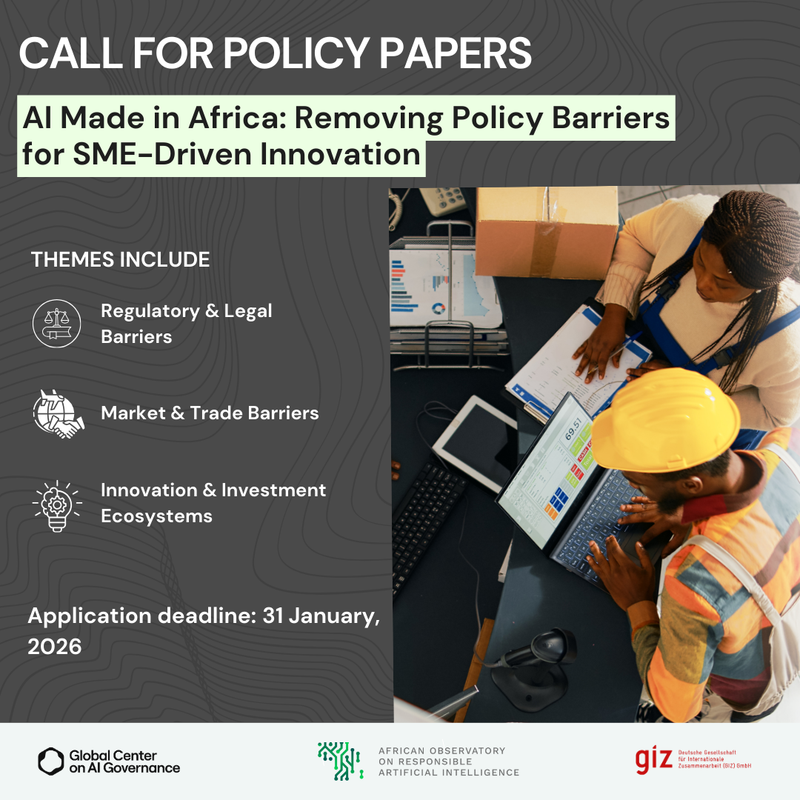
The Global Center on AI Governance, in collaboration with GIZ African Union, is pleased to announce the launch of a new call for policy papers under the AI Made in Africa initiative. This joint effort aims to strengthen Africa’s AI innovation landscape by addressing the policy and regulatory barriers that hinder Small and Medium-sized Enterprises (SMEs), the backbone of the continent’s economies from fully harnessing the potential of Artificial Intelligence. We invite experts to contribute short, policy-focused papers analysing the barriers facing African SMEs and private-sector innovators in the AI landscape. Each paper should present clear, relevant analysis and offer practical policy recommendations tailored to African contexts.
Why This Matters
AI is transforming key sectors across Africa in agriculture, finance, health and logistics. Yet many African SMEs continue to face structural obstacles that limit their ability to use, adapt, or build AI solutions. Some of the major challenges include unclear intellectual property rules, restrictive data policies, fragmentation of standards, weak digital trade frameworks, and limited access to cloud infrastructure all constrain innovation.
The AI Made in Africa policy paper series seeks to fill this gap by generating practical, evidence-based insights to support more enabling environments for responsible and locally grounded AI development.
Goals of the Policy Paper Series
The series aims to:
- Identify legal, regulatory, and market barriers affecting AI innovation by African SMEs.
- Provide actionable recommendations tailored to diverse African contexts.
- Elevate African expertise and perspectives in the global AI policy discourse.
- Support governments, regional bodies, industry, and development partners in fostering sustainable and inclusive AI ecosystems.
Priority Themes
While proposals on any relevant topic are welcome, priority will be given to papers addressing the following high-impact themes:
A. Regulatory & Legal Barriers
- AI and Intellectual Property: copyright, patents, ownership of machine-generated works.
- Data Governance and Access: data sharing, public data infrastructure, cross-border data flows.
- Procurement Rules: challenges for SMEs entering public-sector AI markets
B. Market & Trade Barriers
- AI and Digital Trade: cross-border services, trade facilitation, market access.
- Standards and Certification: interoperability, safety standards, barriers to export.
- Competition and Market Power: how concentration affects African innovators.
C. Innovation & Investment Ecosystems
- Access to Compute and Cloud Infrastructure.
- Skills and Talent: bottlenecks and policy levers.
- Investment and Capital: regulatory barriers to early-stage or impact investment in AI.
- AI and Sectoral Opportunities: agriculture, health, logistics, manufacturing, finance.
Authors may also propose cross-cutting or emerging themes.
NOTE
We thank the researchers, policy experts, and practitioners across the continent who submitted proposals addressing the policy and regulatory barriers shaping responsible and inclusive AI adoption by SMEs in Africa. We received an overwhelming number of high-quality submissions and, due to capacity constraints, will only be able to respond to shortlisted applicants. All submissions are currently under review, and shortlisted applicants will be contacted before the end of February.