How Should Africa Respond to the Growing Power of Artificial Intelligence (AI)?
EventFor years, experts have argued about whether AI could ever override human control. Some believe it’s unlikely; others warn it’s only a matter of time. As Geoffrey Hinton, a leading AI pioneer, put it: the risk is somewhere between 1% and 99%.
Whatever the number, one fact is clear: AI is advancing fast. These systems are more capable, more autonomous, and fueled by some of the largest industrial investments in history. The consequences will be global, and Africa cannot afford to be left out shaping the debate.
As frontier AI spreads into health, education, governance, and beyond, we must ask:
- Are our institutions prepared?
- Do our policies anticipate the risks?
- Are we protecting our ability to steer AI toward public good, while honoring our values, cultures and traditions?
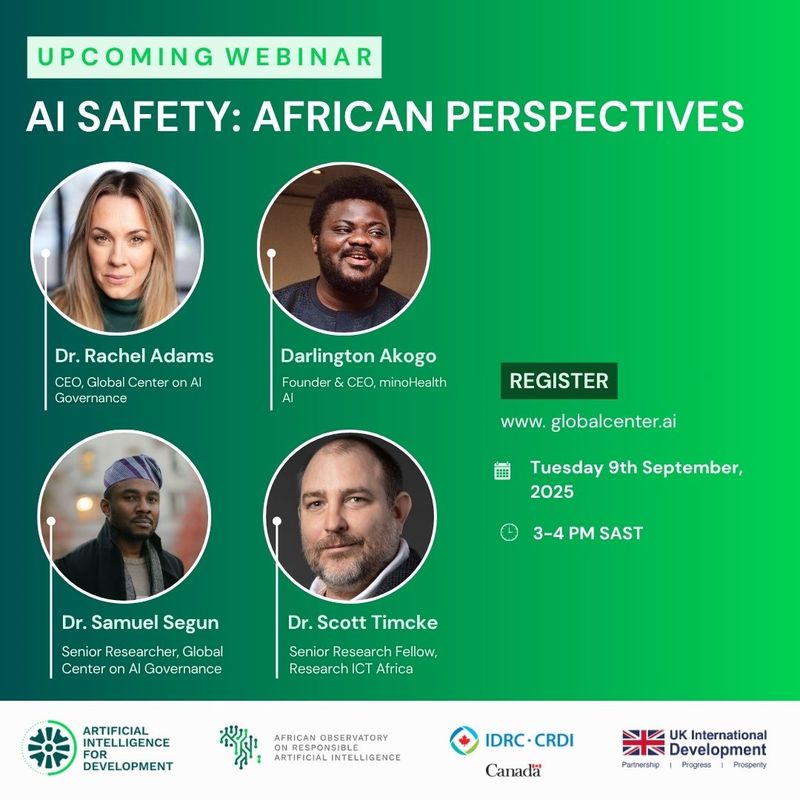
That is the focus of The Big AI Debate: Africa’s Outlook, a new webinar webinar series in collaboration with the Artificial Intelligence for Development Africa (AI4D) program.
Over three conversations, we will explore Africa’s perspectives on the world’s most urgent AI debates:
- AI Safety: What the promises and risks mean for African societies.
- AI and Science in Africa: How AI can accelerate discovery, strengthen research, and tackle pressing challenges in health, agriculture and climate.
- The AGI Debate: Unpacking what Artificial General Intelligence could mean for Africa’s future
First Webinar - AI Safety: African Perspectives
Key takeaways from the webinar:
1. AI Safety is a Broad, Holistic, and Contextual Concern for Africa: The discussion emphasized that AI safety goes beyond narrow technical or "superintelligence" fears, encompassing a holistic range of issues from democratic risks and human rights to socioeconomic and environmental impacts unique to the African continent. It requires an interdisciplinary approach, addressing complex local nuances like resource scarcity, cultural context, and existing governance challenges, and cannot be limited to a single silo.
2. The Risks of AI Misuse are Immediate and Significant, Undermining Global Assumptions: The work of Mino Health AI Labs highlighted a crucial and often overlooked risk, an AI system trained on biological data could be used to design novel, highly toxic agents, immediately challenging the assumption that frontier AI systems are not yet capable of creating biological warfare agents. This demonstrates that developers, even those building AI for good, must proactively address dangerous misuse cases ("red teaming") because global actors may already be doing so, making reactive measures "too late".
3. Continental Coordination and Institutional Capacity are Essential for Safety and Economic Opportunity: Africa needs to build robust local institutional capacity like the proposed AI Safety Institute and increase public literacy to effectively manage AI risks. Furthermore, AI safety is linked to economic market access; by failing to establish appropriate safety and governance standards especially regionally, African countries risk being excluded from global markets and missing out on vast economic opportunities, making investment in safety a commercial imperative.More details on the second webinar, How can AI accelerate Africa’s scientific breakthroughs?